
 Business License

Thermal Conductivity of Insulation Materials: A Specifier's Guide
Ahmed Hassan spent three weeks reconciling quotes for a cold storage expansion in Dubai. One supplier quoted 80 mm rubber-plastic boards. Another quoted 100 mm XPS. Both claimed the same R-value, but the unit prices were far apart.
The difference came down to how each supplier interpreted the thermal conductivity of insulation materials at the operating temperature. Ahmed had assumed one lambda value would apply across the whole temperature range. When his engineer reran the numbers at -20°C, the thinner rubber-plastic no longer met the target U-value. The project had to be respecified, delaying procurement by twelve days.
The thermal conductivity of insulation materials is the single most important number on a technical data sheet, yet it is often misunderstood. It changes with temperature, moisture, density, and material aging. Two insulation products with the same nominal thickness can deliver very different thermal performance if their lambda values differ by even a few milliwatts per meter-kelvin.
This guide explains what thermal conductivity means, how it is measured, how it relates to R-value and U-value, and how to use it when specifying insulation. You will learn why the thermal conductivity of insulation materials should never be treated as a fixed number, and how to compare products fairly across different suppliers and standards. Understanding the thermal conductivity of insulation materials is the first step toward accurate energy modeling and code-compliant designs.
At DaCheng BangMei, operating under Huaneng Zhongtian's 40-year manufacturing group, we publish thermal conductivity values for every insulation material we produce, from Yalong rock wool boards to rubber-plastic insulation and XPS boards. Our technical team helps buyers apply these values correctly for real operating conditions.
What Is Thermal Conductivity?
Thermal conductivity is a measure of how easily heat flows through a material. It is usually expressed in watts per meter-kelvin, written as W/(m·K) or W/m·K. In insulation terminology, it is often called the lambda value (λ). The lambda value insulation shorthand is common among engineers and specifiers.
A lower thermal conductivity means heat moves through the material more slowly, so the material is a better insulator.
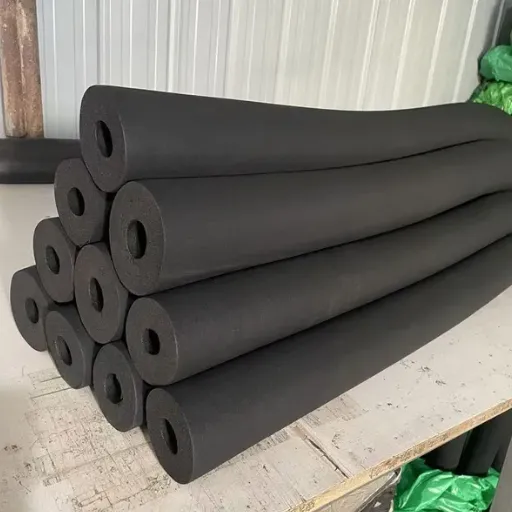
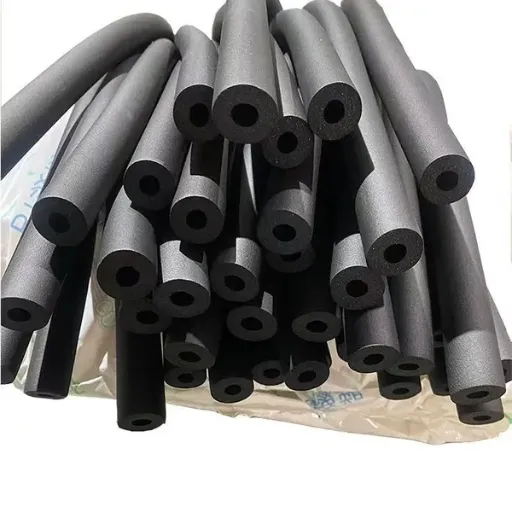
The thermal conductivity of insulation materials depends on the material's internal structure. Closed-cell foams, such as XPS and rubber-plastic, trap gas inside tiny cells, which slows heat transfer. Fiber-based materials, such as rock wool and glass wool, trap air between fibers. The composition, density, binder content, and cell size all influence the final lambda value.
Understanding the thermal conductivity of insulation materials is the first step in comparing products and calculating the right thickness.
Thermal conductivity is not the same as thermal resistance. A material with low thermal conductivity still needs sufficient thickness to achieve a high R-value. This is why specifiers must consider both lambda and thickness together when designing an insulation system. The thermal conductivity of insulation materials tells you what the material can do; thickness determines how much of it you need.
Why Thermal Conductivity Matters in Building and Industrial Applications
Understanding the thermal conductivity of insulation materials matters for several reasons.
It determines how thick an insulation layer must be to reach a target U-value
It affects energy consumption, condensation risk, and occupant comfort
It allows fair comparison between different insulation materials
It is required input for building energy modeling and code compliance
It changes with temperature, so cold-room and high-temperature designs need adjusted values
Need help interpreting thermal conductivity values for your project? Download our complete product technical data sheets or speak with our insulation engineers about temperature-adjusted lambda values.
How Thermal Conductivity Is Measured
The thermal conductivity of insulation materials is measured using guarded hot plate apparatus, heat flow meters, or other standardized methods. These tests measure heat flow through a sample of known thickness when a temperature difference is applied across it. Accurate measurement is essential because small errors in lambda can lead to large errors in calculated thickness.
Guarded Hot Plate Method
The guarded hot plate is the reference method for measuring the thermal conductivity of insulation materials. A flat sample is placed between a hot plate and a cold plate. The plates are guarded at the edges to prevent sideways heat loss.
The heat input required to maintain a steady temperature difference is measured. Thermal conductivity is then calculated from the sample thickness, area, and heat flow.
This method is described in standards such as ASTM C177, ISO 8301, and EN 12667. The test conditions, including mean temperature and temperature difference, must be reported with the result because the thermal conductivity of insulation materials varies with temperature.
Heat Flow Meter Method
The heat flow meter method uses a calibrated heat flux transducer instead of measuring electrical power input. It is faster than the guarded hot plate and is commonly used for quality control. Standards such as ASTM C518 and ISO 8301 cover this method. Results should agree with guarded hot plate measurements when performed correctly.
What Test Reports Should Include
When reviewing thermal conductivity data, check that the report includes:
The test standard used
The mean temperature at which the sample was tested
The declared thermal conductivity value, usually rounded
Sample thickness and density
Any facing or coating on the material
Aging condition, especially for foam products
A lambda value without a stated test temperature is incomplete. For example, a PIR board tested at 10°C may show 0.022 W/(m·K), while the same board at -20°C may show a different value. This is why thermal conductivity W/mK values must always be paired with the test temperature. The W/mK unit is the standard way engineers express thermal conductivity of insulation materials.
Thermal Conductivity, R-Value, and U-Value Explained
Thermal conductivity is only one part of the thermal performance equation. R-value and U-value describe how the material performs in an actual assembly. The thermal conductivity of insulation materials provides the starting point; R-value and U-value complete the picture.
Thermal Conductivity (λ)
Thermal conductivity is a material property. It does not depend on thickness. It tells you how well the material resists heat flow per unit thickness. The units are W/(m·K).
Thermal Resistance (R-value)
Thermal resistance is calculated by dividing thickness by thermal conductivity:
R = thickness / λ
If a 100 mm insulation board has a thermal conductivity of 0.040 W/(m·K), its R-value is 0.100 m / 0.040 W/(m·K) = 2.5 m²·K/W. The R-value depends on both the material and the thickness. Thicker insulation gives a higher R-value.
For R-value insulation calculations, always use the lambda value at the expected operating temperature. Using a catalog value from the wrong temperature can produce a misleading result. R-value insulation ratings are common in North American specifications.
U-Value (Thermal Transmittance)
The U-value describes heat transfer through a complete building element, including all layers, air films, and thermal bridges. It is the inverse of the total thermal resistance of the assembly:
U = 1 / R_total
A lower U-value means better insulation performance. Building codes usually specify maximum U-values for walls, roofs, and floors. U-value insulation targets are easier to meet when designers select materials with low thermal conductivity and sufficient thickness.
U-value is sometimes called the overall heat transfer coefficient because it combines all heat transfer paths through an assembly.
| Property | Symbol | Units | What It Measures |
|---|---|---|---|
| Thermal conductivity | λ (lambda) | W/(m·K) | Heat flow through a material per unit thickness |
| Thermal resistance | R | m²·K/W | Resistance of a specific thickness of material |
| Thermal transmittance | U | W/(m²·K) | Overall heat transfer of a building element |
Sofia Petrov, a building physicist in Warsaw, was asked to review a facade design. The architect had specified 120 mm of mineral wool based on a catalog R-value.
"The catalog R-value was calculated at 10°C," she explained. "Our design temperature was -5°C. At the colder mean temperature, the thermal conductivity of the insulation materials increased slightly, and the assembly U-value missed the code limit by 4%. We had to add 20 mm to the board thickness." The cost increase was small, but the discovery came late in the tender process.
Thermal Conductivity of Common Insulation Materials
The table below shows typical thermal conductivity ranges for the main insulation material categories. Values are given at common mean temperatures around 10°C to 25°C. Always request supplier data for the actual operating temperature.
These typical thermal conductivity values of insulation materials help specifiers narrow the shortlist before detailed calculations. The full thermal conductivity of insulation materials table below covers the main product families used in construction and industry.
| Insulation Material | Typical Thermal Conductivity | Best Applications |
|---|---|---|
| Rock wool (mineral wool) | 0.035-0.045 W/(m·K) | Fire-rated walls, high-temperature equipment, acoustic insulation |
| Glass wool | 0.030-0.040 W/(m·K) | Lightweight roof and wall insulation, HVAC ducts |
| Rubber-plastic (elastomeric foam) | 0.034-0.038 W/(m·K) | Chilled water pipes, refrigeration, condensation control |
| XPS (extruded polystyrene) | 0.030-0.038 W/(m·K) | Below-slab, foundation, roof, high-compressive applications |
| EPS (expanded polystyrene) | 0.030-0.040 W/(m·K) | Lightweight walls, roofs, cost-sensitive projects |
| PIR (polyisocyanurate) | 0.022-0.028 W/(m·K) | Thin roof and wall buildups where space is limited |
| PUR (polyurethane) | 0.022-0.028 W/(m·K) | Panels, spray foam, equipment insulation |
| Phenolic foam | 0.018-0.024 W/(m·K) | Space-constrained walls, rail, marine |
| Nano aerogel felt | 0.015-0.020 W/(m·K) | Ultra-thin high-performance insulation, retrofits |
| Vacuum insulated panels | 0.004-0.008 W/(m·K) | Ultra-thin applications where cost is justified |
The table shows why material selection cannot be based on thermal conductivity alone. Aerogel and VIP offer extremely low lambda values but at high cost. Rock wool has a higher lambda but provides non-combustible fire performance that foams cannot match. The right choice balances the thermal conductivity of insulation materials with fire rating, compressive strength, moisture resistance, and cost.
Factors That Affect Thermal Conductivity
The thermal conductivity of insulation materials is not constant. Several factors can change the effective lambda value in service. Temperature, moisture, density, aging, and compression all play a role.
Temperature
For most insulation materials, thermal conductivity increases as temperature rises. At low temperatures, some gas-filled foams show lower lambda values because the gas inside the cells conducts less heat. At high temperatures, radiation across cell walls becomes more significant, increasing thermal conductivity. The thermal conductivity of insulation materials must therefore be matched to the mean operating temperature, not just to the catalog test condition.
Moisture
Water has much higher thermal conductivity than air or typical insulation materials. When insulation becomes wet, its effective thermal conductivity rises sharply. Closed-cell materials such as XPS and rubber-plastic resist moisture better than open-fiber materials. Even a small increase in moisture content can reduce thermal resistance significantly.
Density
For fibrous insulation, density affects thermal conductivity. Very low-density materials allow too much air movement, increasing heat transfer. Very high-density materials have more solid material conducting heat. Each fiber type has an optimal density range where thermal conductivity is lowest.
Aging and Gas Diffusion
Some foam insulation materials, particularly PUR and PIR, can change thermal conductivity over time as blowing agents diffuse out of the cells and air diffuses in. Manufacturers often provide aged values or long-term thermal resistance values for these products. XPS and EPS are generally more stable.
Compression
Compressing flexible insulation reduces its thickness and can increase thermal conductivity by breaking cell structures or increasing density. Rigid boards should not be compressed during installation. Flexible materials should be installed at their designed thickness.
How to Use Thermal Conductivity in Specification
Using the thermal conductivity of insulation materials correctly requires more than reading a catalog value. Follow this process to avoid common errors and ensure the installed insulation performs as designed.
Step 1: Define the Operating Temperature
Identify the mean temperature the insulation will experience in service. For cold storage, this may be well below 0°C. For industrial equipment, it may be above 100°C. Request lambda values at that mean temperature, not just at the standard test temperature.
Step 2: Choose the Target U-Value or R-Value
Building codes and project specifications usually set a maximum U-value or minimum R-value. Convert this into the required thermal resistance for the insulation layer, accounting for other layers, air films, and fixings.
Step 3: Calculate Required Thickness
Use the formula:
d = λ × R
Where d is thickness in meters, λ is thermal conductivity, and R is required thermal resistance. If you need R = 3.5 m²·K/W and λ = 0.035 W/(m·K), the required thickness is 0.1225 m, or about 123 mm.
Step 4: Compare Products Fairly
When comparing two insulation products, use the same thickness and the same operating temperature. A product with lower thermal conductivity may allow a thinner board, but only if the mechanical and fire properties are also suitable. Do not compare lambda values from different test temperatures or different standards without adjustment.
Step 5: Account for Moisture and Aging
For damp environments, choose materials with low water absorption and include a safety margin. For foam products subject to aging, use the long-term thermal resistance value rather than the initial value if available.
Miguel Torres, a procurement manager in Mexico City, compared two XPS quotes for a warehouse floor. One supplier quoted 0.034 W/(m·K). The other quoted 0.038 W/(m·K) at a lower price.
"At first the cheaper board looked like a 12% saving," Miguel said. "But to reach the same R-value, I needed 12% more thickness. The extra concrete screed and excavation ate the savings." Worse, the cheaper board had higher water absorption. They stayed with the 0.034 W/(m·K) XPS and avoided a long-term risk.
Common Mistakes When Comparing Thermal Conductivity
Even experienced engineers and buyers make errors when interpreting the thermal conductivity of insulation materials. The most common mistakes involve temperature, moisture, units, and assembly details.
Comparing Values at Different Temperatures
A lambda value measured at 23°C cannot be directly compared to one measured at 10°C. The thermal conductivity of insulation materials changes with temperature, so values from different test conditions are not interchangeable. Always normalize to the same mean temperature or request temperature-specific data.
Ignoring Moisture Effects
Catalog values are measured on dry samples. In service, wet insulation performs worse. Design for the actual moisture exposure and include drainage, vapor barriers, or hydrophobic treatments where needed.
Confusing Thermal Conductivity with R-Value
A low lambda does not automatically mean a high R-value. Thickness matters. Two products with the same lambda but different thicknesses will have different R-values.
Using Initial Instead of Aged Values
For gas-filled foams, the initial lambda value may be better than the long-term value. Building codes in some regions require aged thermal resistance. Check whether the design must use aged values.
Forgetting About Thermal Bridging
Fasteners, studs, and structural elements create thermal bridges that reduce the effective R-value of an assembly. A perfect insulation layer can be undermined by poor detailing at junctions and penetrations.
Assuming All Products in a Category Are the Same
Two rock wool boards with the same nominal density can have different lambda values depending on fiber diameter, binder content, and manufacturing process. Two XPS boards can differ in compressive strength and long-term water absorption. Always review the full technical data sheet.
Conclusion
The thermal conductivity of insulation materials is the foundation of every thermal design decision. It determines thickness, cost, energy performance, and code compliance. However, it must be interpreted with care.
Lambda values change with temperature, moisture, density, and aging. They must be combined with thickness to calculate R-value. R-value must then be combined with assembly details to calculate U-value. Each step depends on the previous one being correct.
Specifiers who treat thermal conductivity as a single fixed number risk undersizing insulation, missing code targets, or paying for thickness they do not need. The best approach is to request supplier data at the actual operating temperature, compare products on equal terms, and account for moisture, aging, and thermal bridging in the final design.
Mastering the thermal conductivity of insulation materials helps you specify insulation that performs as expected across the full service life of the building or equipment.
Key takeaways:
The thermal conductivity of insulation materials measures how easily heat flows through a material, in W/(m·K)
Lower thermal conductivity means better insulation performance
R-value depends on both thermal conductivity and thickness: R = thickness / λ
U-value describes the overall heat transfer of a complete building element
Thermal conductivity varies with temperature, moisture, density, and aging
Always compare lambda values at the same mean temperature and test standard
Use long-term thermal resistance values for aging-sensitive foam products
If you need help applying the thermal conductivity of insulation materials to your project, our technical team can assist with U-value calculations, condensation risk analysis, and product selection. We supply rock wool, rubber-plastic, XPS, aerogel, and other insulation materials with full test reports and export documentation.
Ready to specify insulation with confidence? Request a custom quote for your project or speak with our engineers about thermal performance calculations.
Recently Posted
-
Insulation for Metal Buildings: Complete Buyer's Guide 2026
June 24, 2026A warehouse manager in Texas watched his electricity bill climb every summer. The metal roof turned the building into a solar oven Read More
 -
Insulation Materials Comparison: How to Select the Right Type for Your Project
June 24, 2026The procurement manager stared at six quotations on her screen. Each supplier recommended a different insulation material for the Read More
 -
Basement Insulation Board: Complete Buyer's Guide | DaCheng BangMei
June 24, 2026A homeowner in Michigan finished their basement with standard fiberglass batts and drywall. Two winters later, the bottom plates w Read More
 -
Insulation Under Concrete Slab: A Complete Specification and Installation Guide
June 24, 2026The warehouse floor in Calgary looked perfect on opening day. Polished concrete, level, and built to handle forklift traffic. With Read More

Contact Us
Recommended Products
-
 Eco-Friendly Aluminum Foil Foam Board for Underfloor Heating SolutionsNegotiableMOQ: 100 Pieces
 -
Rubber Plastic Insulation Board Waterproof for Industrial Thermal InsulationNegotiableMOQ: 500 Square Meters
-
Premium Soft Silica Nano Aerogel Felt Sheets for Industrial Heat InsulationNegotiableMOQ: 50 Meters
-
Customizable PVC Magnetic Door Curtain Roll for Home & Kitchen UseNegotiableMOQ: 500 Kilograms
-
XPS Waterproof Board for Underground Garage Moisture BarrierNegotiableMOQ: 50 Square Meters
-
Heavy Duty Titanium Steel Mesh Magnetic Door Curtain With Reinforced EdgesNegotiableMOQ: 10 Pieces
-
Rubber Plastic Insulation Tube for Refrigeration & Cold Storage PipelineNegotiableMOQ: 500 Square Meters
-
Durable Aluminum Dry Floor Heating Panel With High Thermal ConductivityNegotiableMOQ: 100 Pieces
-
Nano Aerogel Felt Insulation Material for Cold Protection and Energy EfficiencyNegotiableMOQ: 50 Meters
-
High-Temperature Nano Silica Aerogel Felt for Pipe Fire and Thermal InsulationNegotiableMOQ: 50 Meters
-
Insulated PVC Magnetic Door Curtain for Thermal Insulation in Bedroom & KitchenNegotiableMOQ: 500 Kilograms
-
Professional Aluminum Foil Foam Board for Dry Underfloor Heating SystemsNegotiableMOQ: 100 Pieces
-
Aluminum Underfloor Heating Module for Commercial and Residential UseNegotiableMOQ: 100 Pieces
-
XPS Waterproof Board 10mm Thickness for Roofing InsulationNegotiableMOQ: 50 Square Meters
-
Custom Size Titanium Steel Mesh Magnetic Door Curtain for Warehouse Pest ControlNegotiableMOQ: 10 Pieces
-
Flame Retardant Thermal Insulation Sponge for Rubber & Plastic Pipes - Fireproof Factory DirectNegotiableMOQ: 500 Square Meters
-
Cold Insulation Rubber Plastic Board for HVAC and Industrial Pipeline ApplicationsNegotiableMOQ: 500 Square Meters
-
20mm XPS Thermal Insulation Panel for Dry Underfloor Heating SystemsNegotiableMOQ: 100 Pieces
-
High Temperature Resistant Foam Insulation Tube for Air Conditioner DuctsNegotiableMOQ: 500 Meters
-
XPS Tile Backer Board Waterproof Insulation for Wall & BathroomNegotiableMOQ: 500 Square Meters