
 Business License

Nitrile Rubber Insulation: HVAC and Industrial Applications Guide
Raj Patel, a mechanical contractor in Mumbai, received an urgent call from a client three months after completing a luxury hotel HVAC installation. Water stains were spreading across the lobby ceiling, paint was bubbling, and mold had formed behind the decorative panels. The cause was not a leaking pipe. It was condensation on chilled water lines that had been insulated with open-cell fiberglass. The humid Mumbai air had saturated the fiberglass, and the moisture had migrated through the vapor barrier seams until it pooled above the ceiling tiles. The remediation cost INR 1.2 million and required a full reinsulation with nitrile rubber insulation that actually stopped the condensation.
If you have ever dealt with sweating pipes, dripping ducts, or insulation that turned into a sponge, you already know that not all pipe insulation performs equally in humid or cold conditions. The material you wrap around your chilled water lines determines whether your system runs silently for decades or becomes a source of water damage and energy waste. This guide explains how nitrile rubber insulation works, when to specify it, and how to install it correctly for HVAC, refrigeration, and industrial applications.
At DaCheng BangMei, operating under Huaneng Zhongtian's 40-year manufacturing group, we produce rubber-plastic insulation boards and pre-formed pipe insulation tubes with closed-cell structures, low thermal conductivity, and Class B1 flame-retardant ratings. Our technical team supports specifiers and contractors with condensation risk analysis and insulation thickness calculations. This article draws on that experience to help you select and install nitrile rubber insulation with confidence.
What Is Nitrile Rubber Insulation?

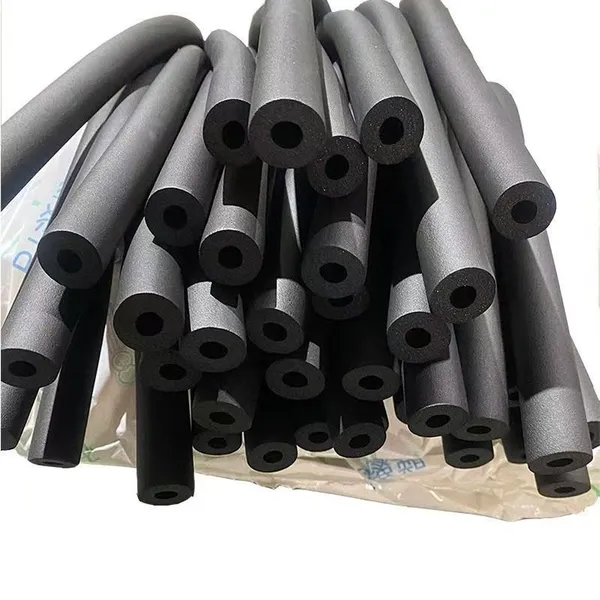
Nitrile rubber insulation is a closed-cell elastomeric foam manufactured from nitrile butadiene rubber (NBR) and polyvinyl chloride (PVC) through a foaming and vulcanization process. The resulting material is flexible, lightweight, and highly resistant to water vapor transmission. Unlike open-cell insulation such as fiberglass or mineral wool, nitrile rubber insulation does not absorb moisture because each cell in the foam structure is sealed.
The nitrile butadiene rubber content provides oil and chemical resistance, which is valuable in industrial environments where insulation may contact lubricants, refrigerants, or cleaning chemicals. The PVC component contributes to the material's flexibility and flame-retardant properties. The combination creates a foam that maintains thermal performance across a wide temperature range while resisting the moisture infiltration that degrades other insulation types.
Nitrile rubber insulation is also known as NBR/PVC foam insulation, elastomeric rubber insulation, closed-cell rubber insulation, or simply rubber foam insulation. These terms all describe the same material family, though formulations vary by manufacturer in terms of density, thermal conductivity, and fire performance.
Key Specifications of Nitrile Rubber Insulation
| Property | Typical Value | Application Relevance |
|---|---|---|
| Thermal conductivity | 0.034-0.038 W/(m·K) | Excellent thermal resistance for pipe and duct applications |
| Service temperature range | -40 degrees C to +105 degrees C | Suitable for chilled water, hot water, and refrigeration lines |
| Water vapor permeability | less-than or equal-to 1.3 ng/(Pa·s·m) | Prevents condensation and moisture absorption |
| Fire rating | Class B1 flame retardant (GB 8624) | Meets code requirements for most commercial buildings |
| Density | 40-80 kg/m3 | Lightweight and easy to handle |
| Compression resilience | greater-than or equal-to 70% | Recovers shape after mechanical stress |
| Closed-cell content | greater-than or equal-to 90% | Ensures moisture resistance |
The closed-cell structure is what differentiates nitrile rubber insulation from open-cell alternatives. In fiberglass or mineral wool, air and moisture can move freely through the material. In nitrile rubber foam, each cell is a sealed bubble. Even if the outer surface is cut or damaged, moisture cannot penetrate deeply into the insulation because there are no connected pathways for water migration.
Need help selecting the right pipe insulation thickness? Browse our rubber-plastic insulation tubes or speak with our insulation engineers about condensation risk calculations for your climate conditions.
Key Properties and Performance Data
Selecting nitrile rubber insulation requires understanding how its properties translate to real-world performance in HVAC and industrial systems.
Thermal Conductivity and Thickness Selection
Thermal conductivity for standard nitrile rubber insulation ranges from 0.034 to 0.038 W/(m·K). This is competitive with fiberglass pipe insulation and superior to polyethylene foam. The low thermal conductivity means that relatively thin insulation can achieve adequate thermal resistance for most HVAC applications.
For chilled water lines operating at 7 degrees C in an ambient environment of 30 degrees C and 70% relative humidity, the required insulation thickness depends on preventing surface condensation. The insulation must maintain the exterior surface temperature above the dew point of the ambient air. A 19 mm thickness of nitrile rubber insulation with thermal conductivity of 0.036 W/(m·K) typically achieves this for standard pipe sizes. For higher humidity or lower pipe temperatures, 25 mm or 32 mm may be required.
DaCheng BangMei's rubber-plastic insulation products achieve thermal conductivity as low as 0.034 W/(m·K), allowing thinner insulation to meet the same thermal and condensation requirements. This is valuable in retrofit applications where space around pipes is limited.
Water Vapor Permeability
Water vapor permeability measures how readily water vapor passes through the insulation material. Lower values mean better vapor resistance. Nitrile rubber insulation achieves values of less-than or equal-to 1.3 ng/(Pa·s·m), which is significantly lower than fiberglass (which has no vapor resistance without an additional vapor barrier jacket).
This property is critical for cold pipe applications. When chilled water flows through a pipe, the pipe surface temperature drops below the dew point of the surrounding air. Without adequate vapor resistance, moisture condenses on the pipe surface and is absorbed by the insulation. Wet insulation loses up to 70% of its thermal performance. Nitrile rubber insulation's closed-cell structure eliminates this problem by preventing vapor from reaching the pipe surface in the first place.
Flexibility and Installation Advantages
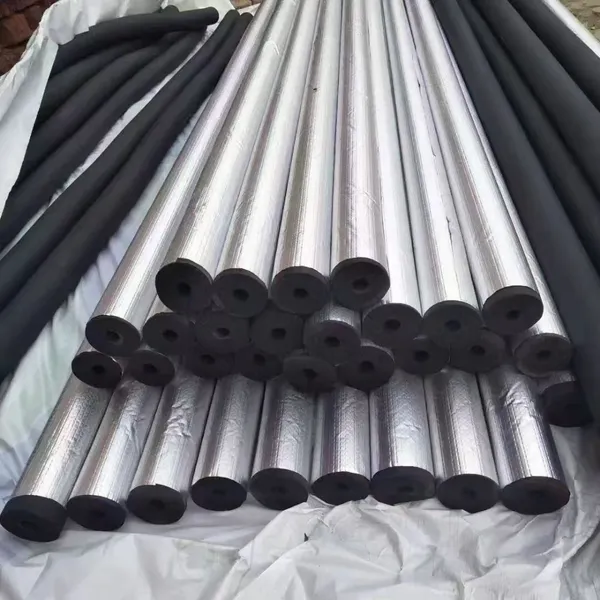
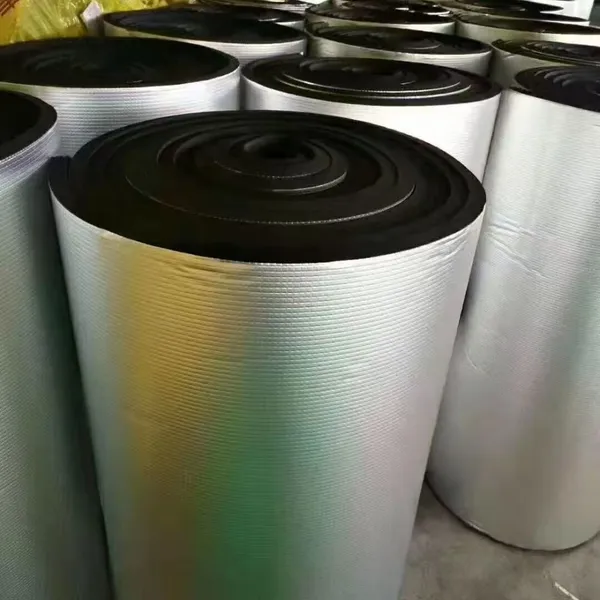
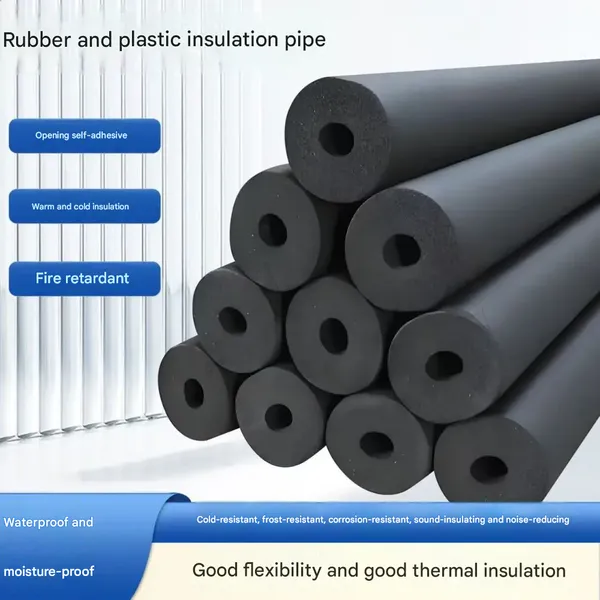
Nitrile rubber insulation is inherently flexible. Sheets can be wrapped around pipes and ducts with minimal cutting. Pre-formed tubes slide directly over straight pipe runs. This flexibility reduces installation time compared to rigid insulation materials that must be cut, fitted, and secured with additional fasteners.
The material can also be stretched slightly around bends and fittings, reducing the number of cuts and seams required. Fewer seams mean fewer potential leak paths for moisture and air.
Fire Performance
Standard nitrile rubber insulation achieves Class B1 flame-retardant rating under GB 8624, which corresponds to limited combustibility. The material self-extinguishes when the flame source is removed and produces low smoke emission. For applications requiring higher fire performance, formulations with enhanced flame retardants can achieve improved ratings.
For buildings with stringent fire codes, such as high-occupancy structures, transit systems, or data centers, always verify that the specific nitrile rubber insulation grade meets local fire safety requirements before specification.
Nitrile Rubber vs. Other Pipe Insulation Materials

Contractors and specifiers often need to justify material selections to project managers or clients. The following comparison provides the technical data needed to make an evidence-based choice.
| Property | Nitrile Rubber (NBR/PVC) | Fiberglass | Polyethylene Foam | Mineral Wool |
|---|---|---|---|---|
| Thermal conductivity (W/(m·K)) | 0.034-0.038 | 0.030-0.040 | 0.040-0.050 | 0.035-0.045 |
| Moisture resistance | Excellent (closed-cell) | Poor (open-cell) | Good (closed-cell) | Poor (open-cell) |
| Flexibility | High | Low (rigid) | Moderate | Low (rigid) |
| Fire rating | Class B1 | Non-combustible A1 | Combustible | Non-combustible A1 |
| Vapor barrier required | No | Yes (mandatory) | No | Yes (mandatory) |
| Installation speed | Fast | Moderate | Fast | Moderate |
| Temperature range | -40 degrees C to +105 degrees C | -20 degrees C to +450 degrees C | -50 degrees C to +90 degrees C | Up to 650 degrees C |
| Cost | Moderate | Low | Low | Moderate |
| Best application | HVAC chilled/hot water, refrigeration | High-temperature steam | Budget residential | Industrial high-temp |
The comparison reveals that nitrile rubber insulation occupies a specific niche: applications where moisture resistance, flexibility, and moderate temperature performance are required simultaneously. It is not suitable for high-temperature steam lines where mineral wool or fiberglass is mandatory. It is superior to fiberglass for chilled water lines where condensation is a risk. It offers better fire performance than polyethylene foam while maintaining similar flexibility.
Elena Kowalski, an HVAC engineer in Warsaw, compared insulation materials for a mixed-use development with both chilled water cooling and district heating. "For the heating lines, we specified mineral wool because of the 80 degrees C supply temperature," she explained. "For the chilled water at 6 degrees C, nitrile rubber was the clear choice. The contractor installed the rubber insulation in half the time compared to the mineral wool sections, and we have had zero condensation complaints in two years of operation. The building management reports a 12% reduction in cooling energy compared to the previous building, which used fiberglass on the same pipe sizes."
Applications for Nitrile Rubber Insulation
The combination of low thermal conductivity, moisture resistance, and flexibility makes nitrile rubber insulation suitable for a wide range of applications.
Chilled Water and Refrigeration Piping
This is the primary application for nitrile rubber insulation. Chilled water lines in commercial HVAC systems typically operate between 5 degrees C and 12 degrees C. At these temperatures, ambient humidity readily condenses on uninsulated or poorly insulated pipes. Nitrile rubber insulation prevents condensation by maintaining the exterior surface above the dew point and blocking vapor transmission.
Pre-formed tubes are available for pipe diameters from 6 mm to 140 mm. For larger pipes or tanks, flat sheets can be cut and wrapped. The insulation is compatible with common refrigerants, making it suitable for direct-expansion refrigeration lines as well as chilled water systems.
Hot Water and Heating Pipes
Nitrile rubber insulation performs well on hot water heating lines up to 105 degrees C. For typical building heating systems with supply temperatures of 60-80 degrees C, the material remains stable and effective. The closed-cell structure prevents moisture ingress during summer shutdown periods when pipes may be cooler than ambient.
For district heating or industrial hot water above 105 degrees C, mineral wool or calcium silicate is required. Always verify the maximum operating temperature of the specific nitrile rubber formulation before specifying it for high-temperature service.
Air Handling Units and Ductwork
Flat sheets of nitrile rubber insulation can be applied to the interior or exterior of ductwork for both thermal and acoustic control. The material's flexibility allows it to conform to irregular duct shapes without gaps. For interior duct lining, verify that the material meets local air quality standards for indoor environments.
Solar Hot Water Systems
Solar thermal systems experience wide temperature swings. During operation, collector temperatures can reach 100 degrees C or higher. During stagnation, temperatures may spike further. Nitrile rubber insulation with appropriate temperature ratings can handle normal solar hot water operating conditions while providing the moisture resistance needed for outdoor installations.
Industrial Process Piping
In industrial settings, nitrile rubber insulation protects process lines from energy loss and condensation. Its oil resistance makes it suitable for compressor lines, lubrication systems, and fuel lines where contact with hydrocarbons is possible. The material's chemical resistance extends to many common industrial fluids, though always verify compatibility with specific chemicals before specification.
Installation Best Practices for Nitrile Rubber Insulation

Proper installation ensures that the performance benefits of nitrile rubber insulation are fully realized. While the process is simpler than rigid insulation installation, attention to detail prevents long-term problems.
Measuring and Cutting
For pre-formed tubes, select the tube inner diameter that matches the pipe outer diameter. Tubes are typically manufactured with an inner diameter slightly smaller than the pipe size to ensure a snug fit. For pipes between standard tube sizes, use the next larger tube size and apply adhesive to close the gap.
When cutting sheets or tubes, use a sharp utility knife or insulation saw. Cut at a 45-degree angle for butt joints on straight runs. Cut miters for bends and elbows. Clean cuts ensure tight joints with minimal gaps.
Adhesive Application
Use a contact adhesive specifically formulated for elastomeric foam insulation. General-purpose construction adhesives may attack the foam or fail to bond properly. Apply adhesive thinly and evenly to both surfaces. Allow the adhesive to become tacky before joining the surfaces. Press firmly along the entire joint to ensure full contact.
Apply adhesive to all longitudinal seams, butt joints, and fittings. A continuous adhesive bond creates a vapor-tight seal that prevents moisture ingress at joints.
Sealing and Finishing
After installing tubes and sheets, seal all joints and seams with matching insulation tape or adhesive. For outdoor or high-humidity applications, apply a protective coating or cladding over the insulation. Common cladding materials include aluminum sheet, PVC jacketing, or weather-resistant paint.
At pipe supports and hangers, use insulated saddles or blocks to prevent compression of the insulation at the support point. Compressed insulation creates a thermal bridge that can cause localized condensation.
Inspection
After installation, inspect all joints, seams, and fittings for gaps or inadequate adhesion. A thermal imaging camera can identify hot or cold spots that indicate air gaps or compressed insulation. Correct any deficiencies before the system operates.
Common Mistakes to Avoid
Even experienced installers make errors that compromise nitrile rubber insulation performance.
Undersizing Insulation Thickness
The most common specification error is selecting insulation thickness based on thermal performance alone without calculating condensation control. A 9 mm thickness may provide adequate thermal resistance for a hot water pipe, but it may be inadequate for a chilled water pipe in a humid environment.
Carlos Mendez, a facilities manager for a resort in Cancun, learned this lesson when replacing insulation on a failing chilled water system. The original specification called for 13 mm nitrile rubber insulation based on thermal calculations for temperate climate conditions. "Cancun humidity averages 75% year-round," Mendez explained. "The 13 mm kept the pipe surface at 24 degrees C, which is below our dew point for most of the year. We were getting condensation on every straight run, not just at the joints. We replaced it with 25 mm insulation, and the surface temperature rose above the dew point. The energy savings from eliminating the wet insulation paid for the upgrade in 14 months."
Always calculate the required thickness based on the lowest operating temperature, highest ambient humidity, and worst-case ambient temperature for the installation location.
Using Incompatible Adhesives
Solvent-based adhesives containing toluene, xylene, or MEK can dissolve nitrile rubber foam. Always use adhesives specifically labeled for elastomeric or rubber foam insulation. If unsure, test the adhesive on a scrap piece of insulation before applying it to the installation.
Ignoring UV and Weather Exposure
Standard nitrile rubber insulation is not UV-stable. Outdoor installations exposed to direct sunlight will degrade, crack, and lose flexibility within months. Always protect outdoor insulation with UV-resistant cladding, paint, or jacketing.
Similarly, standard formulations are not designed for continuous water immersion. While they resist occasional rain and condensation, submersion in standing water will eventually degrade the material. For buried or submerged applications, specify insulation specifically rated for those conditions.
Poor Joint Sealing
The weakest points in any insulation system are the joints. A perfectly installed tube with a poorly sealed longitudinal seam will allow vapor infiltration that compromises the entire insulation run. Take extra time to ensure that all seams are fully adhered and sealed. Apply tape over joints in critical applications for added security.
Conclusion

Nitrile rubber insulation is the material of choice for HVAC chilled water lines, refrigeration piping, and any application where moisture resistance and flexibility are required alongside thermal performance. Its closed-cell structure prevents the condensation problems that destroy open-cell insulation, while its flexibility reduces installation time and labor costs.
When specifying nitrile rubber insulation, match the thickness to both thermal and condensation requirements. Verify temperature ratings for the specific application. Use compatible adhesives and seal all joints properly. Protect outdoor installations from UV degradation.
Key takeaways:
Nitrile rubber insulation's closed-cell structure provides inherent moisture resistance that eliminates condensation on chilled water pipes
Thermal conductivity of 0.034-0.038 W/(m·K) delivers efficient insulation with relatively thin material buildup
Flexibility and pre-formed tube availability reduce installation time compared to rigid insulation materials
Class B1 flame-retardant rating meets code requirements for most commercial buildings
Always calculate insulation thickness based on condensation control, not just thermal performance
Proper adhesive selection and joint sealing are critical to long-term vapor barrier performance
If you are specifying nitrile rubber insulation for an upcoming HVAC or refrigeration project, our technical team can calculate the optimal insulation thickness for your operating temperatures and climate conditions. We can also provide U-value calculations, condensation risk analysis, and certification documentation for code compliance.
Ready to specify? Request a custom quote for your rubber-plastic insulation requirements or download our complete rubber-plastic technical data sheets for detailed thermal conductivity, fire rating, and installation guidance data.
Recently Posted
-
Insulation for Metal Buildings: Complete Buyer's Guide 2026
June 24, 2026A warehouse manager in Texas watched his electricity bill climb every summer. The metal roof turned the building into a solar oven Read More
 -
Insulation Materials Comparison: How to Select the Right Type for Your Project
June 24, 2026The procurement manager stared at six quotations on her screen. Each supplier recommended a different insulation material for the Read More
 -
Thermal Conductivity of Insulation Materials: A Specifier's Guide
June 24, 2026Ahmed Hassan spent three weeks reconciling quotes for a cold storage expansion in Dubai. One supplier quoted 80 mm rubber-plastic Read More
 -
Basement Insulation Board: Complete Buyer's Guide | DaCheng BangMei
June 24, 2026A homeowner in Michigan finished their basement with standard fiberglass batts and drywall. Two winters later, the bottom plates w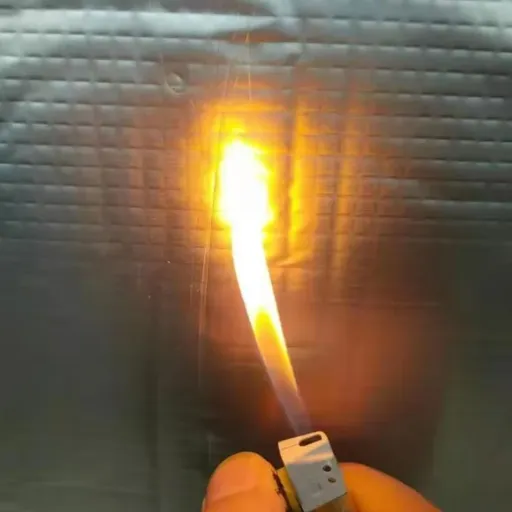 Read More

Contact Us
Recommended Products
-
 Eco-Friendly Aluminum Foil Foam Board for Underfloor Heating SolutionsNegotiableMOQ: 100 Pieces
 -
Rubber Plastic Insulation Board Waterproof for Industrial Thermal InsulationNegotiableMOQ: 500 Square Meters
-
Premium Soft Silica Nano Aerogel Felt Sheets for Industrial Heat InsulationNegotiableMOQ: 50 Meters
-
Customizable PVC Magnetic Door Curtain Roll for Home & Kitchen UseNegotiableMOQ: 500 Kilograms
-
XPS Waterproof Board for Underground Garage Moisture BarrierNegotiableMOQ: 50 Square Meters
-
Heavy Duty Titanium Steel Mesh Magnetic Door Curtain With Reinforced EdgesNegotiableMOQ: 10 Pieces
-
Rubber Plastic Insulation Tube for Refrigeration & Cold Storage PipelineNegotiableMOQ: 500 Square Meters
-
Durable Aluminum Dry Floor Heating Panel With High Thermal ConductivityNegotiableMOQ: 100 Pieces
-
Nano Aerogel Felt Insulation Material for Cold Protection and Energy EfficiencyNegotiableMOQ: 50 Meters
-
High-Temperature Nano Silica Aerogel Felt for Pipe Fire and Thermal InsulationNegotiableMOQ: 50 Meters
-
Insulated PVC Magnetic Door Curtain for Thermal Insulation in Bedroom & KitchenNegotiableMOQ: 500 Kilograms
-
Professional Aluminum Foil Foam Board for Dry Underfloor Heating SystemsNegotiableMOQ: 100 Pieces
-
Aluminum Underfloor Heating Module for Commercial and Residential UseNegotiableMOQ: 100 Pieces
-
XPS Waterproof Board 10mm Thickness for Roofing InsulationNegotiableMOQ: 50 Square Meters
-
Custom Size Titanium Steel Mesh Magnetic Door Curtain for Warehouse Pest ControlNegotiableMOQ: 10 Pieces
-
Flame Retardant Thermal Insulation Sponge for Rubber & Plastic Pipes - Fireproof Factory DirectNegotiableMOQ: 500 Square Meters
-
Cold Insulation Rubber Plastic Board for HVAC and Industrial Pipeline ApplicationsNegotiableMOQ: 500 Square Meters
-
20mm XPS Thermal Insulation Panel for Dry Underfloor Heating SystemsNegotiableMOQ: 100 Pieces
-
High Temperature Resistant Foam Insulation Tube for Air Conditioner DuctsNegotiableMOQ: 500 Meters
-
XPS Tile Backer Board Waterproof Insulation for Wall & BathroomNegotiableMOQ: 500 Square Meters